
Lectures on Execution, Goal Management and Systems Management
Living the core values of "customer orientation, management innovation and win-win cooperation".
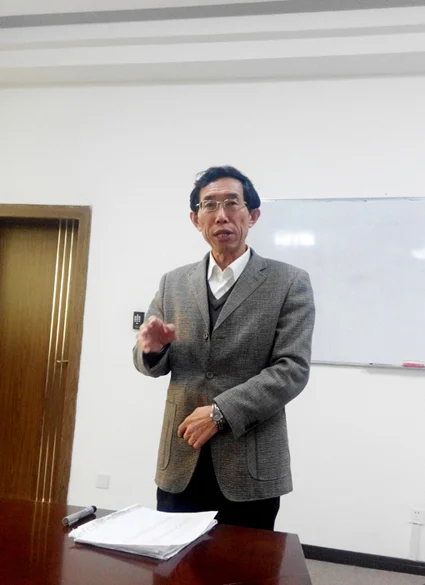
To prepare for a stronger year, on the afternoon of 31 December the company organised a dedicated lecture by senior advisor Wang Zengyou for middle managers and key staff on execution, goal management and systems management.
Mr Wang began from "thinking about knowing and doing", setting expectations and standards for cadres and staff; moved to "thinking about execution" — what it means, how it is classified and how to improve it; then to "thinking about goal management" — its concept, characteristics and why we do it; and finally to "thinking about systems management", citing Qian Xuesen and Bertalanffy to explain its characteristics and how to use systems thinking to analyse and solve problems at work.
He opened with Chen Yinke's "three nots" and the difference Jack Welch draws between knowing and doing, and raised the question of innovation and management. Action needs a starting point: seeing, listening, thinking, speaking, doing and understanding — and understanding is the key. Only by standing at the front of the industry can one really understand, and good summarising is where understanding begins. "Seeing" has three levels: seeing, seeing through, and seeing beyond. He also cited Wang Guowei's three stages of life, and noted that scholarship works the same way: a company whose technology and management lead the industry has a voice. Business success = (model + system + mentor) × effort.
What is execution? It is the ability to use resources fully and effectively to reach a goal on time, at the required quality and in the required quantity — an ability to deliver results. Team execution is what matters, and it divides into individual execution (employees, middle managers, senior managers, the president) and team execution (individual execution plus a good execution environment). How to improve it? For individuals: the ability to operate alone — a sense of crisis, an incentive system, clear goals and plans, and efficiency in execution. For teams: communication as the premise, cooperation, a fast feedback system as the key, and a high sense of responsibility as the culmination.
Goal management means being goal-oriented and result-based: goals are set from the top down and guaranteed from the bottom up. Why do it? Management without goals is not management, and management that fails to reach its goals is failed management. WEDS's 2015 guideline, for example, was "customer orientation, efficient operation", with targets split into business targets and management targets.
Systems management has five characteristics: wholeness, hierarchy, purpose, coordination and adaptability to environment. An enterprise is a system of input and output, where people, money and materials are transformed into output; the transformation is the key — when the elements work together the effect is greater than the sum of the parts, otherwise it turns negative.
How to apply systems thinking at work: (1) analyse the management system as a system — its elements, structure, functions and set. Take goal management: senior management sets the goal; the organisational structure and division of duties are reviewed; subordinate goals are defined; and superior and subordinate agree on the conditions required and the rewards and penalties. (2) A system has one purpose only, and its subsystems must serve and follow that purpose, forming a combined force. (3) Because of wholeness, take the overall view, never look at problems in isolation, and let local interests give way to overall interests. (4) Every system needs a reasonable hierarchy: each level manages only the level below and answers only to the level above, so leaders do the work of their own post and each level performs its own duties with clear responsibility.
Mr Wang closed with Yang Jiang's "Reflections at a Hundred", advising everyone to learn to live happily, to be patient when things are unhappy, and to turn unhappiness into happiness.
Chairman Wang Guannan asked the audience to reflect on and absorb the content and to apply it in product development, production and sales, continuously raising management standards.
The lecture also covered the distinction between technology, product, solution, project and customization: technology can be used by a product, has fixed functions and specifications, and is a key component and highlight of the product; a product can run independently, has a defined function and parameters, ships with documentation and packaging, and is the core of a solution; a solution is a complete set of products a customer can use to obtain value, including software, hardware, network communication and computers; a project is a solution for a specific market segment, a re-definition of the standard solution with limited functional development; and customization and maintenance are small changes for a specific customer's special needs, without functional expansion.
What customers pay for are customization, projects and solutions, and how good, how mature and how competitive these are depends on the technology and on how well the product manager does the job.
In the new year the company will hold to the guideline of "customer orientation, efficient management" and work to achieve its development goals.